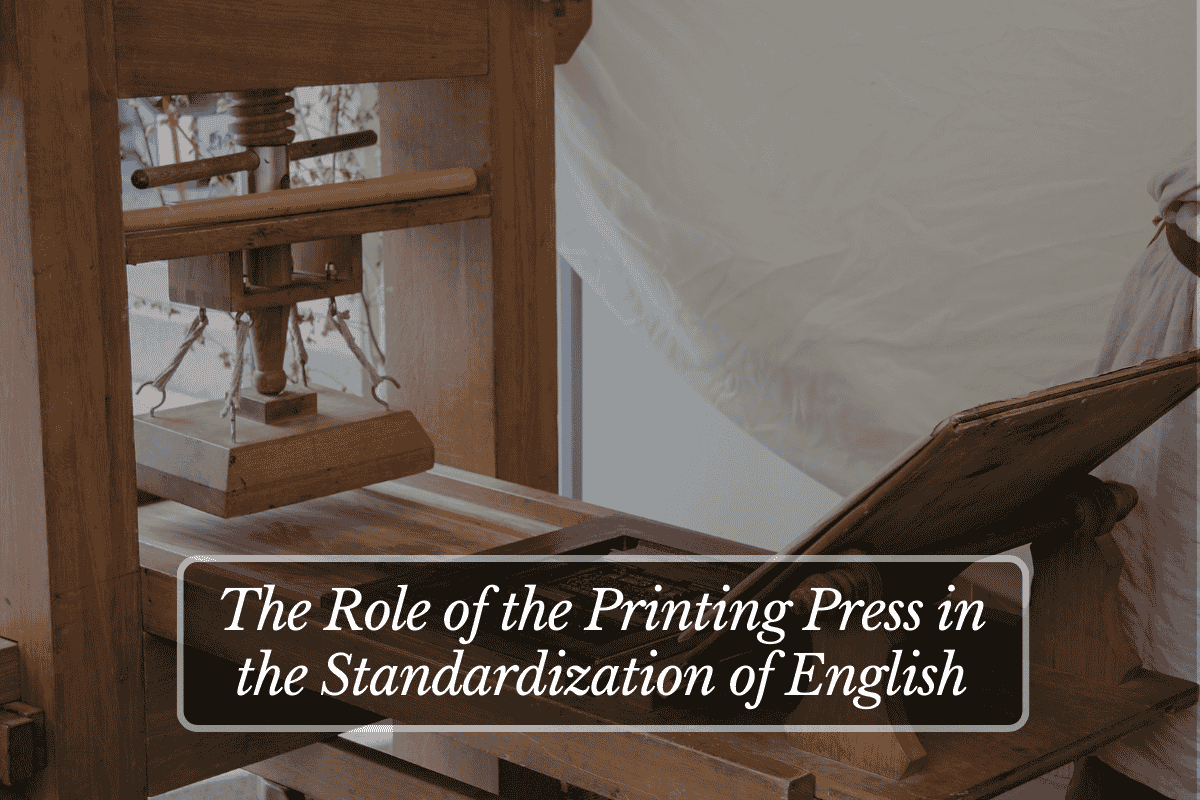
The printing press revolutionized English standardization by enabling mass production of texts, which fixed spellings, grammar, and punctuation into consistent forms, elevating the London dialect as the national norm.
Pre-Printing Linguistic Chaos
Before the 15th century, English spelling varied wildly by region, scribe, and dialect, with no uniform rules—words like “knight” appeared as “knyght” or “cnicht.” Pronunciation shifted during the Great Vowel Shift, but writing lagged behind. Hand-copied manuscripts perpetuated inconsistencies, hindering communication across England’s dialects.
William Caxton’s Pivotal Role
In 1476, William Caxton introduced England’s first printing press, printing works like Chaucer’s Canterbury Tales using the London dialect spoken by elites. His Flemish-influenced choices, such as “gh” in “night” or “ou” in “house,” became widespread through identical copies distributed nationwide. This homogenized orthography, syntax, and vocabulary, overriding regional variations like Kentish or Northumbrian.
Mechanisms of Standardization
- Mass Replication: Identical books spread uniform spellings, teaching readers consistent forms they replicated in letters and documents.
- London-Centric Printing: Most presses clustered in London, embedding its dialect as the prestige standard across Britain and colonies.
- Author and Printer Influence: Intellectuals’ works set norms, with printers correcting errors for efficiency, stabilizing grammar amid oral changes.
- Literacy Boom: Affordable texts boosted reading, reinforcing printed conventions over spoken diversity.
Long-Term Legacy
The press widened the gap between spoken and written English, laying groundwork for dictionaries and grammars by the 18th century. It propelled English’s global spread via Bibles, literature, and trade, though colonial presses later diverged into American variants. Standardization facilitated the Renaissance, Reformation, and modern publishing.
FAQ
Q1: How did Caxton choose which English dialect to print?
He selected the London dialect, used by educated elites, for its prestige and practicality in his Westminster press.
Q2: Did the printing press immediately standardize English?
No, initial prints retained author errors, but growing demand led printers to enforce uniformity for efficiency.
Q3: Why did London English become the national standard?
Presses concentrated there, distributing its forms widely and associating it with power and commerce.
Q4: What spelling changes did Caxton introduce?
Influenced by Flemish, he popularized “gh” (night), “ou” (house), and consistent endings like “-eth.”
Q5: How did printing affect English vocabulary and grammar?
It expanded lexicon via translations and stabilized syntax through repeated exposure in mass texts.