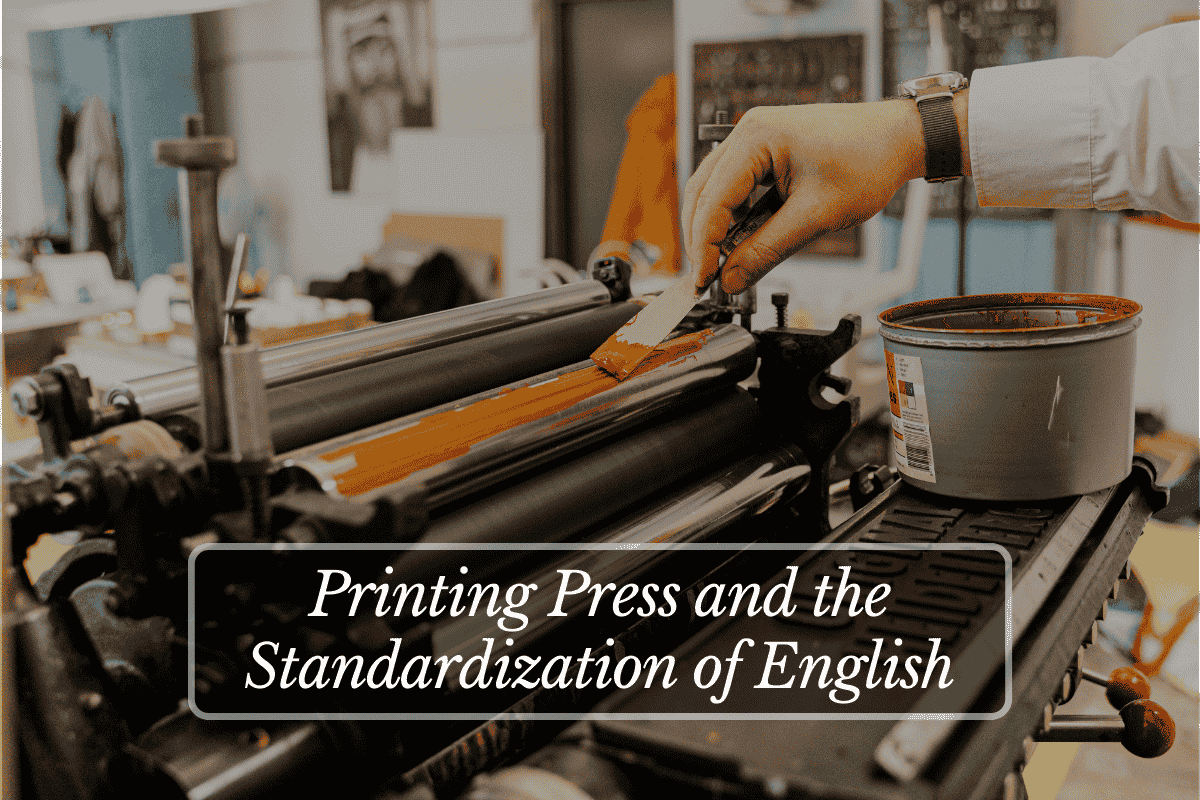
The printing press played a pivotal role in the standardization of English by enabling the mass production of written materials, which helped unify spelling, grammar, and vocabulary across different regions.
Printing Press and the Standardization of English
Historical Context
- Before the printing press, English spelling and grammar varied widely by region and even individual writers, due to the absence of centralized publishing and common standards.
- The invention of the printing press by Johannes Gutenberg around 1440 revolutionized the production and distribution of books, making literature more accessible.
Impact on English Language
- Mass Production of Texts: Printed books became widely available, exposing readers to more consistent forms of spelling and grammar used by printers and publishers.
- Early Dictionaries and Grammarians: The press facilitated the dissemination of dictionaries and grammar guides, which began regulating language use and enforcing standards.
- Uniformity Across Regions: Printed texts helped reduce local linguistic variations, promoting a more standardized English understood by a broader audience.
- Literacy and Education Growth: As more people accessed printed materials, literacy increased, reinforcing the adoption of standardized language forms.
- Influence of Prominent Works: Books like the King James Bible and Shakespeare’s plays, widely printed and distributed, influenced English usage and vocabulary.
Modern-Day Legacy
- The printing press laid the foundation for the lexicographers and linguists who developed comprehensive dictionaries such as Samuel Johnson’s in the 18th century.
- It established a tradition of printed English as a dominant form in education, media, and governance, shaping contemporary English worldwide.
Frequently Asked Questions (FAQ)
Q: How did printing affect English spelling?
A: Printing introduced consistency by adhering to specific spellings chosen by printers, reducing the many regional variants.
Q: Did the printing press immediately standardize English?
A: Standardization was gradual, occurring over centuries as printed materials spread and educational resources developed.
Q: What role did dictionaries play after printing?
A: Dictionaries helped codify spelling, meaning, and pronunciation for a wider audience, reinforcing standard usage.
Q: How did printed works influence spoken English?
A: While spoken language remained diverse, printed English influenced formal education and public communication standards.
Q: Is modern English spelling still influenced by the printing press?
A: Yes, many standard spellings and grammatical rules trace their origins to early printed materials and dictionaries.