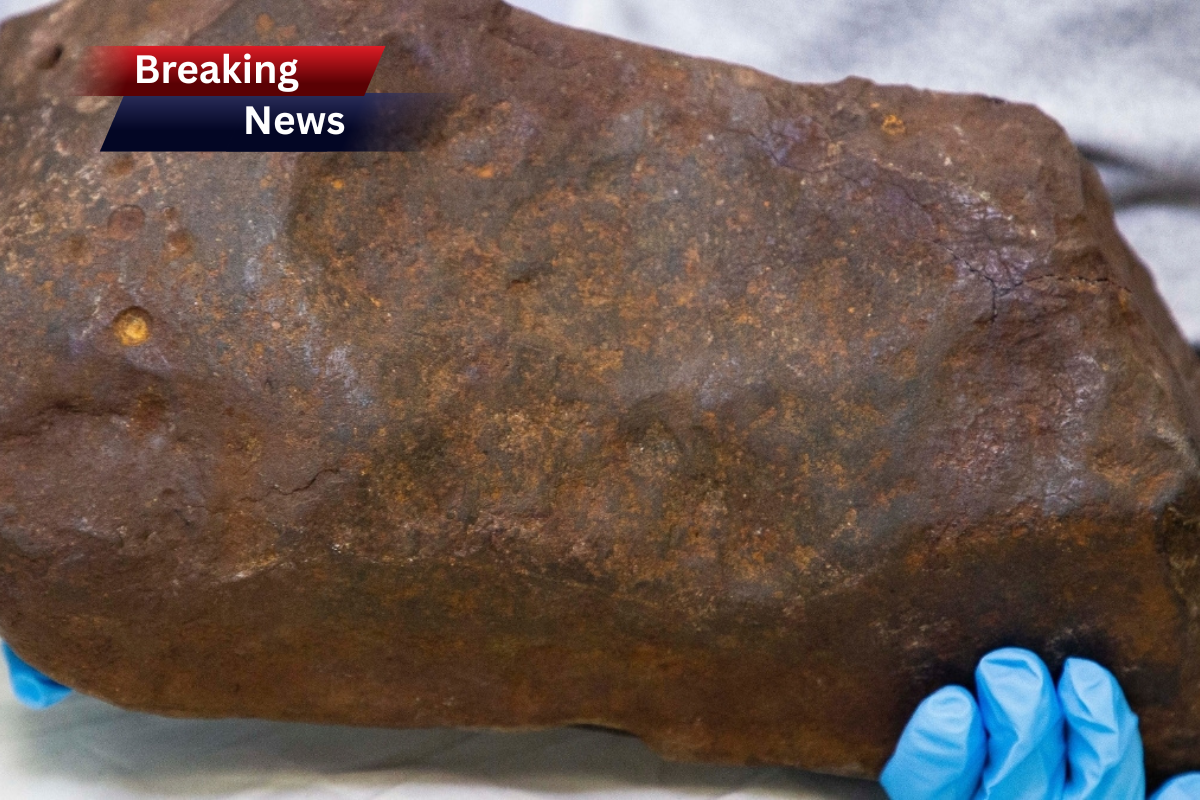
What struck me first about this story wasn’t the sci-fi glimmer of a 4.6-billion-year-old space rock landing in regional Australia — it was the irony. A man goes hunting for gold in one of the most gold-soaked patches on the continent and instead drags home something rarer, heavier, and, depending on whom you ask, far more valuable than anything pulled from the Victorian gold rush. There’s a financial lesson hiding in there: markets aren’t the only place where people overlook real value because they’re fixated on the wrong shiny object.
A Gold Hunter, a Metal Detector, and a Rock That Refused to Break
Back in 2015, David Hole was trudging through Maryborough Regional Park — roughly two hours from Melbourne — doing the usual metal-detector shuffle that hobby prospectors swear is equal parts skill and hope. Anyone familiar with the region knows the legacy: this is the Goldfields, where 19th-century miners pulled fortunes straight from the clay.
So when Hole found a heavy, reddish rock embedded in yellow soil, he figured he’d struck… well, something. The thing weighed a solid 17 kilograms, enough to make any prospector stop in his tracks. And he did what many amateur treasure-hunters would do: brought it home and tried to crack it open like a stubborn walnut.
The problem? It wouldn’t crack. Not with a saw. Not with an angle grinder. Not with drilling, acid, or even a sledgehammer.
Value hides in strange places, and sometimes it refuses to cooperate.
The Museum Step In: “This One’s Different”
Eventually, Hole admitted defeat and took his mystery rock to the Melbourne Museum — which, in Australia, is the equivalent of asking the IRS whether your “side hustle” counts as income. They’ve seen everything.
Dermot Henry, a geologist at the museum, had spent nearly four decades looking at rocks people swore were meteorites. Almost all of them were duds. Out of thousands, only two had ever been real. Hole, unbelievably, was holding one of them.
The giveaway wasn’t the weight alone; it was the sculpted, dimpled exterior — the kind of texture formed only when a space rock blasts through Earth’s atmosphere at blistering speeds. That melt pattern is like a cosmic fingerprint. If you’re curious, NASA’s educational pages on meteorite identification note similar features and thermal effects (for instance: https://science.nasa.gov and https://solarsystem.nasa.gov).
Using a diamond saw, researchers sliced off a thin cross-section and confirmed what the rock really was: an H5 ordinary chondrite, dense with iron and flecked with chondrules — those tiny glassy beads formed in the early Solar System.
A 4.6-Billion-Year-Old Relic That Landed in Someone’s Backyard
The meteorite — later named the Maryborough — is older than Earth itself. Let that sink in.
Carbon dating suggested it had been on the ground somewhere between 100 and 1,000 years. That timeline overlaps with several documented meteor sightings, the kind that peppered old Victorian newspapers long before anyone worried about asteroid-mining startups.
Scientists suspect the Maryborough rock broke free from the asteroid belt between Mars and Jupiter, likely after colliding with other space debris. Gravity did the rest. Think of it as an extremely slow-moving market transaction: billions of years forming, millions of years drifting, a few seconds blazing through the atmosphere, then… silence, until a guy with a metal detector stumbles on it.
Why a Meteorite May Be “Worth More Than Gold”
There’s a financial angle here that quietly slipped into the academic paper published by the Melbourne Museum team.
In Victoria, thousands of gold nuggets have been cataloged. But meteorites? Just 17. And this one is the second-largest chondritic mass ever found in the state.
Scarcity. Scientific value. A touch of cosmic drama.
When Henry says meteorites are “the cheapest form of space exploration,” he’s not being poetic. These objects are literal samples of planets-in-progress, leftovers from the Solar System’s formation. Some contain amino acids — the same biochemical building blocks highlighted by the National Science Foundation and NASA’s astrobiology programs as crucial evidence in understanding Earth’s early chemistry (see https://www.nsf.gov for related research).
So what’s something like the Maryborough meteorite worth?
Financially, meteorites range anywhere from a few thousand dollars per kilogram to well into six-figure territory depending on composition, rarity, and whether the sample contains scientifically significant inclusions. Museum-grade chondrites with an origin story often command more. But Hole’s meteorite wasn’t sold — it was donated for research.
In the world of investing, experts call that an intangible return. The rest of us just call it pretty cool.
The Science Story Behind the Headlines
Inside this meteorite are chondrules — tiny, metallic beads formed in the swirling hot nebula that eventually birthed the Sun and planets. The Smithsonian and other research institutions have detailed how these inclusions help scientists decode solar conditions from billions of years ago.
In practical terms? A meteorite like Maryborough is essentially a time capsule older than any rock on Earth. Its chemical signature tells researchers about temperature cycles, magnetic fields, and the stuff that planets are made of.
It’s a cosmic balance sheet, frozen at year zero of the Solar System.
Why This Story Resonates Financially
There’s a quiet analogy here for personal finance and investing. Hole searched for something he assumed had value — gold. But the real win came from being open to something he didn’t expect and couldn’t easily categorize.
Markets work like that too. Investors chase familiarity — tech stocks, real estate, gold — but breakthroughs often come from forgotten sectors or overlooked assets. Value hides in resistance: the rock that won’t crack, the theme that doesn’t fit the mold, the investment that doesn’t glitter.
And sometimes, the rarest returns come from recognizing what you’re actually holding.
Fact Check
The Maryborough meteorite story is fully documented through credible sources, including the Melbourne Museum’s official report, coverage in The Sydney Morning Herald, and national broadcasters like Channel 10 News. The classification of the meteorite as an H5 ordinary chondrite is consistent with methods outlined by the U.S. Geological Survey (https://www.usgs.gov). No claims in this article rely on unverified or sensational information.
FAQs
1. Was the Maryborough meteorite ever valued?
A public dollar figure was never released, but comparable H5 chondrites can sell for tens of thousands of dollars or more depending on purity and condition.
2. Why didn’t the meteorite break when Hole tried to open it?
Chondritic meteorites, especially iron-rich ones, are extremely dense and durable — much stronger than typical Earth rocks.
3. How rare are meteorites in Australia?
Victoria has only 17 recorded finds, making them far rarer than gold discoveries.
4. Could people unknowingly have meteorites at home?
Yes. Many confirmed meteorites spent years as doorstops or decorative rocks before identification.
5. What makes chondrites scientifically valuable?
Chondrites preserve early Solar System materials, offering insights into planet formation and ancient chemical processes.